
Jul 8, 2025
ingenit attends Materna's Resilience Day
Resilience – the ability to withstand difficult situations – is becoming increasingly important for companies. That's why Materna, together with Infora, the IHK zu Dortmund (Dortmund Chamber of Commerce and Industry) and the HWK Dortmund (Dortmund Chamber of Crafts), organized a full day of talks and workshops.
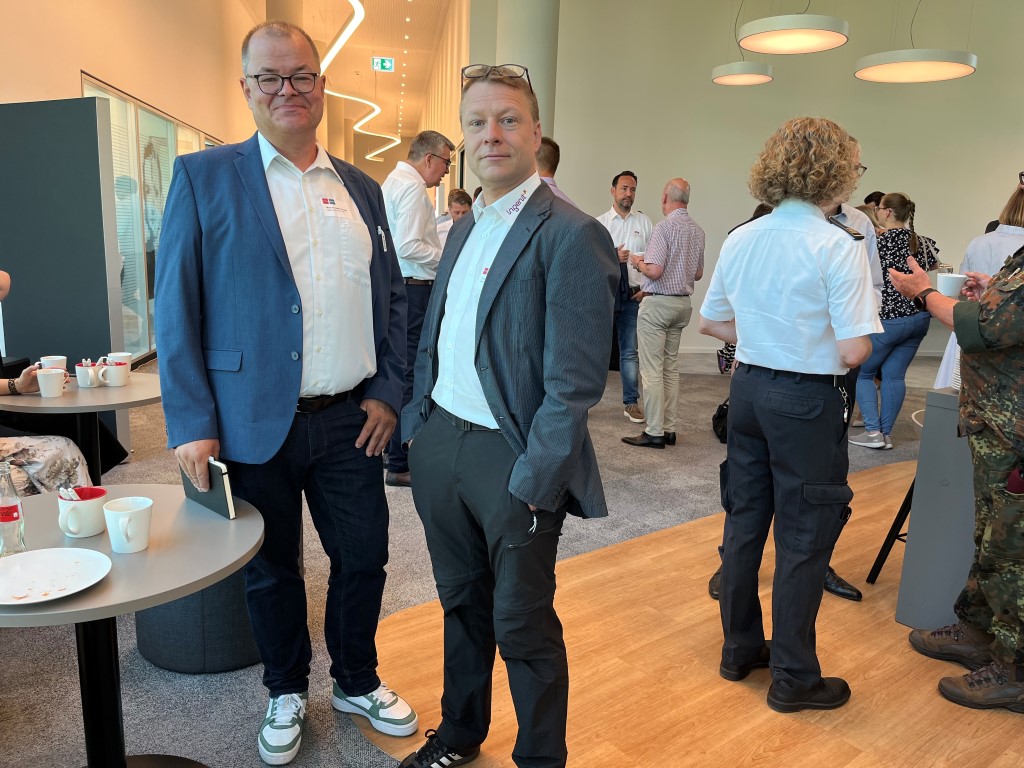
The day had finally come: ingenit – represented by Thomas Klute, Marc-Christian Schröer and Catrin Unrath – attended Resilience Day at Materna's new headquarters.
After a warm welcome and a brief introduction to the day, everyone listened to a compelling talk by Colonel (GS) Armin Schaus on “Operationsplan Deutschland (Operation Plan Germany) – a task for the whole of government and the whole of society”. Colonel (GS) Schaus, Head of Civil-Military Cooperation at the Bundeswehr Joint Forces Operations Command, discussed current and future threat scenarios and possible developments. Familiar, relatable examples made it easy to follow his assessment and the challenges that come with it. His conclusion: these challenges cannot be tackled by the armed forces or politics alone. Rather, they are tasks for society as a whole, which also affect civil society – that is, private individuals and private-sector companies.
This was followed by a keynote from Andreas Könen, formerly of the BMI (Federal Ministry of the Interior), who explored how businesses, public administration and politics can position themselves resiliently, effectively and efficiently against threats from cyberspace. His conclusion was that resilient and operational cybersecurity architecture must be tackled now – because if it isn't done in peacetime, it will have to be made up for in a hectic and uncoordinated way during a crisis.
Before lunch, there was a panel discussion with Colonel (GS) Armin Schaus, Wulf-Christian Ehrich (Deputy Chief Executive of the IHK zu Dortmund), Dr. Constantin Terton (Head of Economic Policy, Zentralverband des Deutschen Handwerks – German Confederation of Skilled Crafts) and Lieutenant General (ret.) Martin Schelleis (Federal Commissioner for Crisis Resilience, Security Policy and Civil-Military Cooperation, Malteser). As the audience's active participation via QR code made clear, it is not only the speakers but also the participants who are dealing with resilience-related topics. Many are currently working on cybersecurity, physical protection, crisis management and business continuity management, among other things. They named the complexity of the topic as well as a lack of staff and time as the biggest challenges. Mr. Ehrich and Dr. Terton in particular confirmed this impression from their conversations with member companies. The participating organizations already have initial measures in place – above all risk analyses, resilience strategies and crisis communication plans. The results came as no surprise, since most of those surveyed were already dealing with the topic in some depth. One critical remark – that the best plans are useless if nobody knows about them – bridged the gap to the three afternoon workshops.
In the workshops, participants worked on different focus topics: “Full throttle in the crisis team: from zero to hero in 60 minutes”, “Fit for the new reality: how to become strategically resilient” and “Strong people, strong organization – people at the heart of the resilience strategy”. The results were briefly presented at the end of the event. Participants developed approaches for acting quickly, in a structured way and with confidence in an emergency, for preparing strategically for crisis scenarios, and for anchoring people as the central factor in their resilience strategy.
Taking part in Resilience Day reinforced our conviction that resilience is not a one-off project but a continuous process. We were particularly impressed by the interdisciplinary perspective – from military security strategy and economic policy approaches to the importance of corporate culture.
If you'd like to dive deeper into resilience, and the Operationsplan Deutschland in particular, we recommend the following sources (in German):
- Green paper on civil-military cooperation 4.0 (Grünbuch Zivil-Militärische Zusammenarbeit 4.0)
- Guide to emergency preparedness and how to act in emergencies
For ingenit, one thing is clear: we will use the insights we gained to further strengthen our own structures and to work for and with our customers on a resilient digital future.